 Bot for Kalshi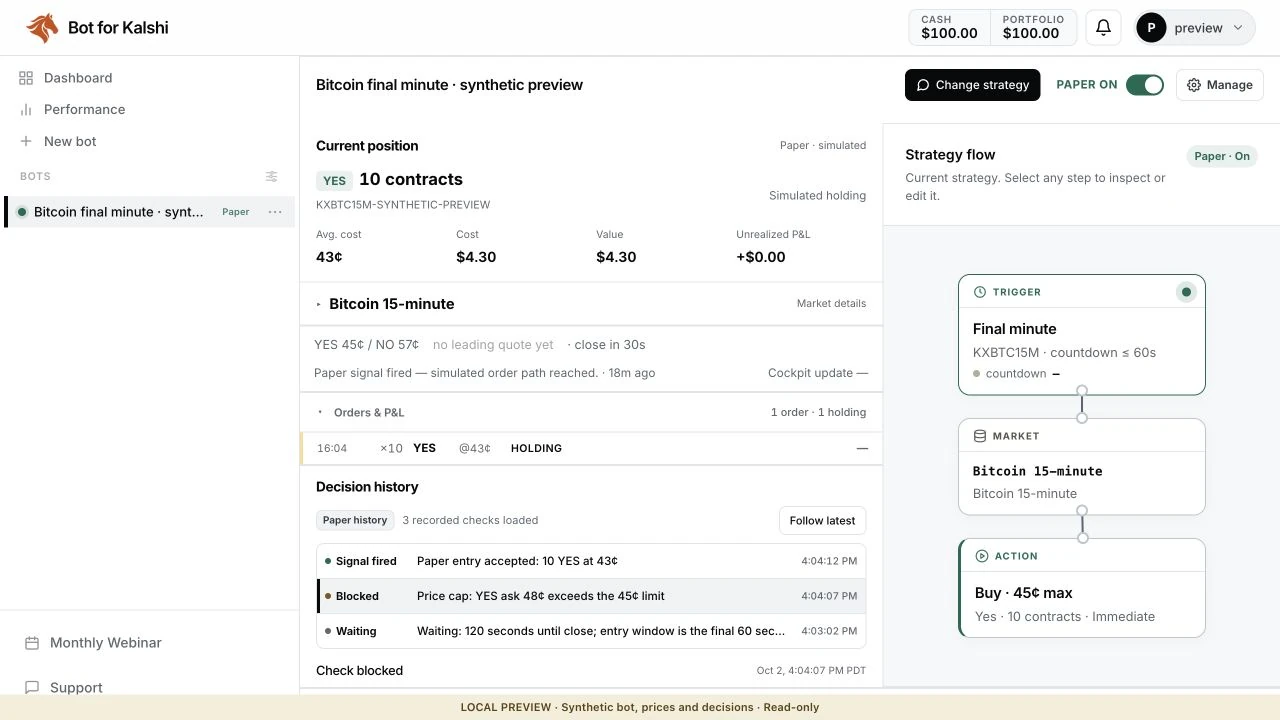
For traders who want their own rules running on Kalshi without writing code, Bot for Kalshi is the option we built for that job: one Complete plan runs up to 10 live bots with hosting included, and Paper testing needs no Kalshi API key. Developers who want full control should look at the official SDKs and open-source code instead. This is a publisher-disclosed guide from the team behind Bot for Kalshi, not an independent ranking.
If you searched "Kalshi trading bot for sale," the short version: nothing reputable is sold as a one-time download with a guaranteed return. The honest market in 2026 is a mix of hosted services (you bring your account and rules; the platform runs them — what Bot for Kalshi is), open-source code on GitHub you can run yourself, and a handful of copy/signal services that mirror a small leaderboard of opt-in users. Below is the same buyer's view we use internally — what each option costs, who it fits, and what to avoid.
We verified our own product against its code. Outside products are described from their public pages, so confirm their current capabilities, pricing, and terms before choosing one.
How to Evaluate
Use the same six criteria for every option, then verify each answer in the current product or primary documentation:
- Ease of setup — How fast can you go from zero to placing your first automated trade?
- Strategy flexibility — Can you express the strategies you actually want to run?
- Reliability — How does it expose downtime, retries, reconciliation, and missed or partial fills?
- Risk management — Built-in position limits, stop losses, kill switches?
- Value — Is the pricing reasonable for what you get?
- Verification depth — Did we inspect current code and behavior, a logged-in product, or only the vendor's public claims?
Apply those checks yourself. Product pages and repository descriptions are starting points, not proof of uptime, security, execution quality, or profitability.
Which Kalshi Bot Tool Should You Use?
| Use case | Best fit | Why | Watch out for |
|---|---|---|---|
| First no-code bot | Hosted no-code builder such as Bot for Kalshi | Lower-infrastructure path from a supported rule to paper/live workflow. | Verify current inputs, risk controls, activity visibility, and pause behavior. |
| Developer learning the API | Kalshi Python SDK or open-source repo | Maximum control and the best way to understand order/fill mechanics. | You own auth, hosting, retries, monitoring, and P&L reconciliation. |
| Weather or external-data rule | Supported no-code trigger, or custom Python | Today's NWS high/low at supported stations can drive a no-code threshold; other sources may require custom code. | Verify station support, cache cadence, source availability, licensing, and fees. |
| Cross-venue research | Analytics tool first, execution tool second | Finding divergence and trading it are separate jobs. | Settlement mismatch makes many apparent arbs fake. |
| AI/news signal research | Custom LLM agent feeding a rules engine | LLMs are useful for text extraction, not unchecked trade decisions. | Do not let a model size or place orders without deterministic guardrails. |
| Copy-trading style flow | Read-only Whale Tracker plus your own rules | Inspect anonymous large-fill flow without pretending to copy a trader identity. | The tracker does not place orders and flow is not an automatic signal; spread, liquidity, and your own thesis still matter. |
Publisher Product: Bot for Kalshi
What it is: A web-based platform for building multi-step automated trading bots on Kalshi, without writing code.
What we like:
- Visual bot builder — Create complex multi-step chains with conditions like price thresholds, fill triggers, and timed delays. No coding required.
- Supported rule inputs — The current catalog includes Kalshi price/time conditions; selected ESPN game events; NFL/NBA/MLB/NHL injury headlines; today's NWS high/low at supported stations; NWS alerts; crypto/equity prices; SEC filings and earnings; geophysical events; and two named polling aggregates. RSS/keyword, arbitrary macro-release, sportsbook-consensus, and candidate-race feeds are not runnable product triggers.
- Hosted execution — The engine evaluates configured conditions on its operating cadence and can submit limit orders through Kalshi's API while the service, exchange, and required upstream source are available. Up to 10 bots can run live at once on one Complete plan, with no separate compute bill.
- Paper without a key — Paper mode reads public Kalshi market data, so you can test a rule before connecting a Kalshi API key. Real money needs your own verified Kalshi account and key.
- Security — API credentials are encrypted at rest. Your keys are never stored in plaintext.
- Risk controls — Account-level loss caps, position limits, stop conditions, and a visible control that requests a pause on new actions. A pause does not guarantee instant exchange cancellation or close existing positions.
What could be better:
- No built-in historical backtesting engine; paper mode is forward testing and does not reproduce live fills
- Limited to Kalshi — no cross-platform trading
- No native ICE/EIA/AAA, CPI/jobs/Fed-funds, sportsbook-consensus, NWS-probability, or RSS/keyword trigger
Pricing: Bot for Kalshi has one Complete plan at $99 per month, for up to 10 live bots. Complete includes the AI and visual builders, Paper and real-money operation, hosted execution, supported triggers, and risk controls. See the current plan page for included limits.
Best for: Traders who want their own rules running on Kalshi without writing code, especially several bots at once or rules that react to sports, weather, filings, or polling events. Sports bettors crossing over to prediction markets.
Setup: No-code reduces infrastructure work, but timing varies with account connection, rule complexity, and the review needed before paper or live operation.
Hosted Alternative: Turbine
What it is: A hosted, plain-English strategy builder that backtests supported markets and deploys each bot to a dedicated sandbox runner on a third-party compute provider. It advertises Kalshi and Polymarket.
How it compares in the same units (Turbine's public pricing and sandbox-runtime pages, checked October 22, 2026):
- Bots running at once: Turbine lists Starter ($9/month) for one bot at a time, Basic ($99/month) for three, and Pro ($199/month) for five. Bot for Kalshi Complete runs up to 10.
- Compute: Turbine's runtime page says runner compute on Starter and Basic is billed at cost through X402 top-ups, on top of the subscription. Bot for Kalshi includes hosted execution in Complete.
- Testing: Turbine advertises historical backtesting and paper trading. Backtest results depend on the fill, spread, and fee assumptions in the model; they are not live results.
- Rule inputs: its pricing page lists crypto, weather, and arbitrage bots. Check that your input is supported.
Best for: Traders who specifically need historical backtesting or Polymarket, and who are comfortable budgeting runner compute separately.
Also compare: Elastics now advertises a free AI terminal with Kalshi and Polymarket connections, natural-language agents, simulation, and continuous execution. Its public app leads to sign-in; we have not tested those capabilities. Hosted automation is not necessarily a paid-only category.
Bring a strategy. Watch it become a bot.
Join the free live build on October 27 at 6:00 PM Pacific. Bring a market and a rule, or just watch. We’ll build a draft, review the workflow, demonstrate paper mode, and answer your questions.
We'll email the calendar invite and reminders for this webinar. Registering does not create an account. See our Privacy Policy.
Custom Development: Official Kalshi SDKs
What it is: Kalshi's current Python SDKs (kalshi-python-sync and kalshi-python-async) for interacting with the REST API and WebSocket feeds. The older kalshi-python package is deprecated.
What we like:
- Direct integration — Build against the endpoints and permissions in Kalshi's current official documentation.
- Custom logic — Add your own authorized data sources, models, storage, and monitoring.
- Source control — You own the implementation and can audit every decision path.
What could be better:
- You build and maintain everything yourself
- No built-in risk management — you have to code it
- Rate limits require careful handling
Pricing: Free (you pay for your own hosting).
Best for: Developers and quants who want full control. Complex strategies that can't be expressed in a visual builder. Anyone who enjoys building systems.
Setup: Varies widely. Authentication is only the beginning; production work includes state, retries, reconciliation, monitoring, secrets, and testing.
If this is your path, our step-by-step Python bot tutorial will get you there fast.
Cross-Venue Analytics Tools
What it is: Oddpool is a read-only, cross-venue analytics and data platform for Kalshi, Polymarket, and other prediction markets. It detects and exports data; it does not place Kalshi orders for you. Coverage, matching quality, latency, pricing, and execution support can change, so verify the current product directly.
What we like:
- Research separation — Use comparison data as an input to due diligence, not as an automatic trade instruction.
- Contract matching — A credible tool should expose settlement-source, cutoff, scope, fee, and liquidity differences.
- Free research access — The public pricing page offers free dashboards, paper trading, and a limited API allocation. It also lists an institutional offering by quotation.
What could be better:
- A quoted divergence is not arbitrage; contracts and settlement rules may differ
- Data delay, fees, spreads, one-sided fills, and funding constraints can erase a gap
- The pricing page says Oddpool is no longer accepting new subscriptions. It still displays legacy Pro at $30/month and Premium at $100/month, both marked unavailable; existing subscriptions and free accounts continue. Do not assume those paid tiers can be purchased today.
Potential fit: Researchers who will independently verify contract identity and execution risk.
Source checked: Oddpool's first-party pricing and availability notice, September 8, 2026.
Custom LLM Agents
What it is: Custom-built AI agents using Claude, GPT, or Gemini to process information and generate trading signals for Kalshi markets.
What we like:
- Unstructured data processing — Can read news articles, social media, earnings calls, and extract tradeable insights.
- Adaptable — Unlike rule-based bots, AI agents can handle novel situations.
- Multi-agent architectures — Separate agents for research, signal generation, risk assessment, and execution.
What could be better:
- Expensive to run (LLM API costs add up)
- Unpredictable — LLMs can hallucinate or make irrational decisions
- Requires significant engineering to build reliably
- Not for beginners
Best for: Advanced developers exploring the cutting edge. Research-heavy strategies that require processing diverse data sources.
Full Comparison Table
| Tool | Type | Coding required | Public price checked September 8 | Best for | Main tradeoff |
|---|---|---|---|---|---|
| Bot for Kalshi | Hosted no-code builder | No | $99/mo Complete, up to 10 live bots, hosting included | Several Kalshi bots on one plan; rules on sports, weather, filings, and polls; Paper without an API key | Kalshi only; no historical backtesting |
| Turbine | Hosted builder + runner | No at the user layer | From $9/month for 1 bot at a time, plus runner compute (rechecked October 22) | Advertised backtesting and Polymarket | 3 bots at a time on the $99 plan; compute billed separately on Starter and Basic |
| Official Kalshi SDKs | SDK / library | Yes (Python) | Software may be free; you fund hosting and operations | Full-control developers | You own hosting, safety, and maintenance |
| Oddpool | Research / data API | No for dashboards; yes to build integrations | Free; institutional quotation; legacy paid subscriptions unavailable to new buyers | Cross-venue research and data | Research/data access is separate from an order-execution bot |
| kalshitradingbot.net | Hosted rules engine (vendor claim) | No at the user layer | $39 / $99 / $249 | Price shoppers willing to verify the product | We verified the public sales page, not execution, custody behavior, or results |
| Custom LLM agents | AI research layer | Yes | Varies | Advanced text-heavy research | Model output needs deterministic execution and risk gates |
| Open-source repos | Code you inspect and run | Yes | Hosting and maintenance still cost money | Learning and custom forks | Maintenance and production readiness vary |
Why no score for the exact-match seller? kalshitradingbot.net's public page currently advertises Kalshi API-key automation and three USD plans, but a public sales page is not an execution test. Until we can verify a real build-to-paper/live workflow without using production credentials, we list its status and price without turning vendor claims into a rating.
The "Open-source repos" row above compresses a whole category into one line, so if that is the route you are weighing, our catalog breaks it out project by project: compare 35 Kalshi bots side by side on strategy, GitHub stars, and repository before you clone anything.
What to Look for in a Kalshi Bot
Regardless of which tool you choose, make sure it has:
- Reliable execution — Missed trades cost real money. The bot needs to handle API errors, reconnections, and rate limits gracefully.
- Risk controls — Position limits, loss limits, and a kill switch are non-negotiable.
- Audit trail — Every trade should be logged with timestamps, prices, and the reason the bot traded. You need this for debugging and tax reporting.
- Security — Your API keys should be encrypted. Never use a service that stores credentials in plaintext.
- Active maintenance — Kalshi updates their API. Markets change. The tool needs to be actively maintained.
Our Verdict
If you trade on Kalshi and don't want to write or host code, start with Bot for Kalshi. One Complete plan runs up to 10 live bots with hosting included, each built from a plain-English rule you can inspect, with account risk controls and an activity log, and you can test in Paper before connecting a Kalshi API key. If historical backtesting or Polymarket matters more to you than running several bots, compare Turbine. Developers who need custom logic may prefer an official SDK, while Oddpool belongs upstream as a separate research/data layer rather than in the execution slot. If you also trade Polymarket, our prediction market bots guide covers tools for both exchanges.
The "best" tool ultimately depends on your skills and goals. A quant with Python experience might prefer building from scratch. A sports bettor trying automation for the first time needs a visual builder. Match the tool to your situation — and if you want the platforms lined up side by side, our Kalshi bot alternatives comparison does exactly that. Whichever you pick, the tool is only half the equation — decide which Kalshi trading strategies you want to run before you commit to a platform, because the strategy dictates the features you actually need.
Frequently Asked Questions
Quick answers to common questions about Kalshi Trading Bot Options & Tools (2026 Publisher Guide).
What is the best Kalshi trading bot?
If you don't code and want your own rules running on Kalshi, Bot for Kalshi: one Complete plan runs up to 10 live bots with hosting included, builds each bot from a plain-English description, and lets you test in Paper on public market data before connecting a Kalshi API key. Developers who want full control can use the official Kalshi SDK or an open-source repository instead, and take on hosting and maintenance. We build Bot for Kalshi, so treat this as the publisher's view and check the comparison above.
Can you buy a Kalshi trading bot?
Be skeptical of anything sold as a one-time 'Kalshi bot for sale' with a guaranteed return — nothing reputable works that way. The legitimate market is hosted services (you bring your account and rules), open-source code on GitHub, and a few copy/signal services. Avoid any product promising fixed profits.
Are Kalshi trading bots profitable?
A bot is only as profitable as the strategy behind it. Automation removes emotion and enforces rules, but it doesn't create an edge that isn't there — most traders, automated or not, lose money. Treat any tool advertising guaranteed returns as a red flag. Past performance is not a guarantee of future results.
Do I need to know how to code to use a Kalshi bot?
No. A no-code builder can express supported entry, step, and risk rules visually and paper-test them against live prices. Coding is required when the rule depends on an unsupported external feed or arbitrary model. See our no-code builder guide for the current boundary.
Are Kalshi trading bots legal?
Kalshi publishes an official trading API, but that is not blanket legal approval for every strategy or jurisdiction. Bot for Kalshi is independent software that places orders through your own account; you remain responsible for current Kalshi terms, market rules, and local availability. This is general information, not legal advice.
Cite this guide
Using this guide in an article or research summary? Please credit Bot for Kalshi and link to this page so readers can check the source and its latest updates.
Bot for Kalshi Team. Kalshi Trading Bot Options & Tools (2026 Publisher Guide). Bot for Kalshi. Updated October 22, 2026.