 Bot for Kalshi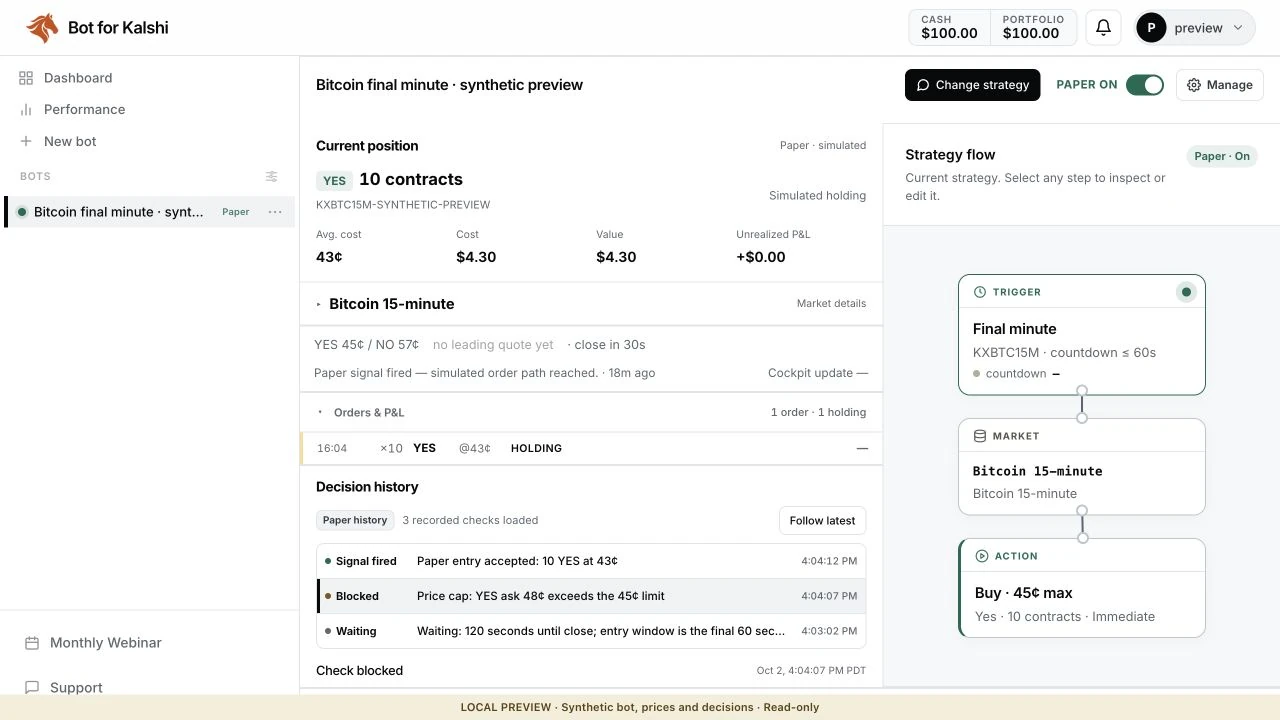
Prediction markets give individual traders a direct way to test a view, and bots can execute a well-defined rule consistently. Whether you're a developer building a custom system or a trader automating without code, this guide covers the mechanics, limits, and risks of Kalshi bots.
Inspect your first Paper rule
The limit-and-hold Paper recipe (sign-in required) turns a fixed market, side, price ceiling, close window, and contract count into a stopped draft you can review. It has no automatic exit. Read the Operator Note on an explained skip for a reproducible condition check and the limits of that evidence. An entry that correctly stays idle is useful information; a first trade is not the only sign that a rule was evaluated.
We build and operate Bot for Kalshi, so this guide comes from product and market-mechanics work, not from a neutral review desk. A bot is only as good as the strategy it runs — if you came for research frameworks such as weather-model comparison, sports hypotheses, or market making, our guide to Kalshi trading strategies is the companion to this one.
Does Kalshi Allow Bots?
Kalshi publishes official API documentation for programmatic market data and trading. Access, credentials, rate limits, fees, permissions, and terms can change, so verify the current developer documentation and account eligibility before placing orders.
If you are comparing developer surfaces rather than implementing Kalshi immediately, the Gemini Predictions vs Kalshi API comparison separates public discovery, tradable identifiers, authenticated order paths, sandbox scope, and source identity.
An official API is not an exemption from platform or market-conduct rules. Before trading, review Kalshi's current terms and market rules for restrictions on manipulation, wash trading, spoofing, self-matching, account access, and jurisdiction. Automation changes execution, not your responsibility to comply.
What Are Kalshi Trading Bots?
A Kalshi trading bot is software that automatically places, manages, and closes trades on the Kalshi prediction market exchange without requiring you to click buttons manually. At its simplest, a bot watches a market, evaluates a condition, and places an order when that condition is met. At its most complex, it's a multi-agent system running machine learning models across dozens of markets simultaneously.
But let's be clear about something: a bot is not a magic money printer. A bot is an execution layer for a strategy. If your strategy doesn't have edge, automating it just means you'll lose money faster. The value of a bot is consistent rule execution, less manual reaction time, and the ability to monitor more conditions than a person can watch alone. It all starts with a testable signal. If you want the practical steps, see how to automate Kalshi trades without code.
This is also why "copy trading on Kalshi" is mostly a misnomer — Kalshi's public trade feed does not identify the account behind a fill. Its social profiles and opt-in leaderboard are separate surfaces; following a profile is not automatic order mirroring. You can inspect anonymous, one-directional flow in our free, read-only Kalshi Whale Tracker. Treat it as a research lead, not an instruction; automatically trading that flow requires a custom data integration today.
Kalshi makes bot trading possible through the REST API and WebSocket workflow, which provides programmatic access to:
- Real-time market data (prices, volumes, orderbook depth)
- Order placement (market orders, limit orders, with full parameter control)
- Portfolio management (positions, balances, fill history)
- Market discovery (search, filter, and enumerate available contracts)
The website and API overlap, but they are not identical surfaces. Available endpoints, order types, permissions, and rate limits can change, so build against the current official API documentation instead of assuming feature parity.
Why Use a Bot on Kalshi?
You might be wondering: why bother with automation when you can just trade manually? Here are the real reasons, from people who actually run bots:
1. Speed and Latency
Prediction markets can move quickly around news. Automation can evaluate a supported rule without waiting for you to open an app, but data arrival, evaluation cadence, exchange availability, order submission, and fills all add latency. Treat faster reaction as something to measure, not a promised number of seconds.
2. Scale
Kalshi can list many contracts across weather, sports, economics, and politics. Our Kalshi election bot guide covers those political markets, and the sports side has its own calendar — a football slate lands every week of the season, which the Kalshi NFL bot guide walks through market by market, while the Kalshi sports bot guide lists the supported triggers across every league in one place. A bot can monitor the specific markets and conditions you configure without keeping browser tabs open. Coverage and evaluation cadence depend on the bot, market, service health, and exchange limits; Bot for Kalshi does not promise every market or a fixed polling interval.
3. Discipline
This is the one nobody wants to talk about. You had a plan: buy at 30 cents, sell at 55 cents, risk no more than $50 per market. Then the price dipped to 25 and you panic sold. Then it ran to 60. A bot does not have those emotions; when it is online and operating normally, it follows the rules you configured. That consistency still depends on correct logic, healthy integrations, and active monitoring.
4. Hosted Coverage
A hosted bot can evaluate configured rules while your laptop is closed. Coverage still depends on service health, exchange access, the selected market, and any upstream source; it is not a guarantee of uninterrupted operation.
5. Backtestable Strategies
Codifying a strategy makes it testable, but historical backtesting requires a separate point-in-time dataset and test harness; Bot for Kalshi does not currently include a built-in historical backtesting engine. Bot Builder Paper mode uses live quotes to model fills, fees, positions, and P&L in a separate virtual account. It never submits a Kalshi order, and modeled results do not reproduce queue position, latency, partial fills, rejection, slippage, or live performance.
Types of Kalshi Bots
Not all bots are created equal. Here's the taxonomy:
Signal-Based Bots
These are the most common. They watch for a specific signal — a price crossing a threshold, a weather forecast updating, a news event occurring — and execute a predefined trade when the signal fires.
Example: "When the GFS model updates and shows Chicago's high temperature exceeding 85°F, buy YES on the Kalshi 'Chicago over 85°F' contract if the price is below 60 cents."
Signal-based bots are great for traders who have identified specific market inefficiencies and want to capture them systematically.
Market-Making Bots
Market makers provide liquidity by simultaneously posting buy and sell orders, aiming to capture the bid-ask spread. On Kalshi, where many markets are thinly traded, a well-tuned market-making bot can earn that spread by being the counterparty to other traders — though it carries real inventory risk and is not guaranteed profit.
Warning: Market making on Kalshi requires significant capital, sophisticated inventory management, and a deep understanding of the fee structure. It's not a beginner strategy. Read our market making deep dive before attempting this.
Arbitrage Bots
These look for price discrepancies — either between venues or between related contracts on one venue. A quoted gap is not automatically profit: contract wording, settlement sources, timing, fees, liquidity, transfer delays, and one-sided fills can leave a supposedly hedged trade exposed.
Cross-venue arbitrage is intensely competitive, and apparent intra-platform gaps also need contract-by-contract verification. Treat every candidate as a hypothesis to validate, not a risk-free trade.
Multi-Step Chain Bots
These execute a sequence of trades based on cascading conditions. Step 1 places an order; when it fills, Step 2 evaluates a new condition and places another order; and so on. This is how you build complex strategies like:
- Scale into a position as the price moves in your favor
- Automatically take profit at a target price
- Hedge a position by entering a correlated market
- Run a recurring daily strategy that resets each morning
Multi-step bots are what we specialize in at Bot for Kalshi. Our visual bot builder lets you create these without writing a single line of code.
AI-Powered Bots
The newest category. These use large language models (LLMs) like Claude or GPT to process unstructured data — news articles, social media sentiment, earnings calls — and generate trading signals. They can also use machine learning models trained on historical market data to predict price movements.
AI bots are powerful but complex. We cover them in depth in our AI & Automation guide. And if you're wondering whether bots are taking over Kalshi — the answer might surprise you.
How Kalshi Bots Work (Architecture)
Every Kalshi bot, regardless of complexity, follows the same basic loop:
┌─────────────────────────────────────────────┐
│               BOT LOOP                       │
│                                               │
│  1. OBSERVE    → Fetch market data / signals  │
│  2. EVALUATE   → Check conditions / models    │
│  3. DECIDE     → Generate trade signal        │
│  4. EXECUTE    → Place/modify/cancel orders   │
│  5. MONITOR    → Track fills, update state    │
│  6. MANAGE     → Risk checks, position limits │
│  7. REPEAT     → Loop back to step 1          │
│                                               │
└─────────────────────────────────────────────┘
Let's break down each step:
1. Observe
The bot fetches data. This could be Kalshi market prices via the REST API, real-time orderbook updates via WebSocket, external data feeds (weather APIs, news APIs, sports data), or any combination.
2. Evaluate
The bot evaluates its conditions against the data. Is the price above my threshold? Has the weather forecast changed? Did a player get ruled out? This is where your strategy logic lives.
3. Decide
Based on the evaluation, the bot decides whether to trade, and if so, what. Buy or sell? Yes or No side? How many contracts? Limit or market order? At what price?
4. Execute
The bot sends the order to Kalshi via the API. A well-built bot handles all the edge cases here: rate limits, insufficient balance, market closed, price moved, etc.
5. Monitor
After placing an order, the bot monitors for fills. Limit orders might sit on the book for minutes or hours. The bot needs to track whether they filled, partially filled, or need to be cancelled and repriced.
6. Manage
Risk management happens continuously. The bot checks position sizes against limits, total exposure against bankroll rules, and whether any stop-loss conditions have been hit.
7. Repeat
The loop cadence is implementation-specific. It can be scheduled, polled, or event-driven, and every design must account for stale data, rate limits, downtime, and exchange latency.
Building vs. Buying a Bot
You have two paths: build a custom bot from scratch, or use a hosted Kalshi bot platform like Bot for Kalshi that provides bot-building tools. Here's the honest comparison:
| Factor | Build Custom | Use a Platform |
|---|---|---|
| Flexibility | Custom within the API, account, data, and venue constraints you implement | Constrained to the platform's current features |
| Setup effort | You build, host, and test the system | Hosted setup is usually lower, but varies by rule and account |
| Coding Required | Yes (Python recommended) | No |
| Maintenance | You own code and operations | Platform manages hosted infrastructure; you still monitor the account |
| Cost | Hosting costs (~$5-20/mo) | Platform subscription |
| Best For | Developers, quants, complex strategies | Traders, non-coders, quick setups |
Our recommendation: start with the smallest paper-testable workflow that expresses your rule, then use custom code if you need unsupported logic or data. Check the builder's current inputs before subscribing; no fixed percentage captures every trader's requirements.
If you want to go the custom route, start with our Python bot tutorial. If you want the fast path, try our no-code bot builder. Before you commit to building, it is also worth seeing what already exists: compare 35 Kalshi bots side by side in our catalog, sortable by strategy and GitHub stars, since a working public repo in your category can be cheaper to study than to reinvent.
Bring a strategy. Watch it become a bot.
Join the free live build on October 27 at 6:00 PM Pacific. Bring a market and a rule, or just watch. We’ll build a draft, review the workflow, demonstrate paper mode, and answer your questions.
We'll email the calendar invite and reminders for this webinar. Registering does not create an account. See our Privacy Policy.
Getting Started: Your First Bot
Here's the minimum viable path to running your first Kalshi bot:
Step 1: Get Your API Keys
Create a Kalshi account if you haven't already, then generate API credentials from account settings. Since October 1, 2026, Kalshi's web app creates an Ed25519 key pair by default; RSA is still offered for tools that support only RSA signing. Save both the API key ID and the downloaded private-key file; Kalshi will not show that private key again after you leave the creation screen.
Step 2: Choose Your Approach
- Code it yourself: Follow our Python bot tutorial, then budget time for authentication, persistence, reconciliation, monitoring, and testing. Our guide to deploying a Kalshi bot to production covers hosting it to run continuously.
- No-code builder: Use Bot for Kalshi's visual builder to create and paper-test supported multi-step rules without maintaining a server. Get started — $99/month.
Step 3: Start Small
For a concrete example, follow the Bitcoin setup walkthrough: select the intended recurring series, inspect a price ceiling, and review Paper skips before considering a live workflow.
Your first bot should be simple. Here's a good starter strategy:
- Pick a single market you understand well (e.g., a current-day NYC high-temperature contract, or a Bitcoin price market — our primer on how betting on Bitcoin works explains those contracts)
- Define a clear entry condition (e.g., "If today's supported NWS Central Park forecast high is above 78°F, submit a YES limit at 40 cents or less")
- Set a position limit ($10-20 max)
- Let it run for a week and observe
Do not start by building a 50-market multi-strategy system. That's how you lose money and get discouraged.
Step 4: Monitor and Iterate
Review the activity log. Are the entry conditions evaluating when you expect? Bot Builder Paper mode models fills, fees, positions, and P&L in a separate virtual account without submitting Kalshi orders. In real-money mode, verify fills and P&L directly against Kalshi; modeled Paper results cannot reproduce live queue position, latency, partial fills, rejection, or slippage. If your live numbers ever look off, our guide on why a bot's P&L can look wrong covers the usual causes. Adjust based on observed data, not gut feeling.
Popular Bot Strategies
Here are common strategy families worth researching and paper-testing. Their results vary by market, timing, execution, and fees:
Weather Model Divergence
Compare a station-specific forecast distribution with the market price, then test whether any gap survives forecast error, fees, spread, and settlement details. Model agreement is a research signal, not an instruction to trade. Our Kalshi weather bot walkthrough turns that rule into a paper build. Full weather strategy guide →
Sports Prop Value Hunting
Use sports analytics models (player projections, matchup data, injury reports) to form a probability estimate, then test it against point-in-time prices, spread, fees, liquidity, and fill risk. Bot for Kalshi can check supported NFL/NBA/MLB/NHL injury headlines on a cached cadence; upstream publication and availability still control freshness. For the cross-sport list of supported triggers, start with our Kalshi sports bot guide; for a football-specific build, see the Kalshi NFL bot playbook. Full sports strategy guide →
Economic Release Fading
One testable hypothesis is that some economic indicator markets overreact to a recent print and later mean-revert. Our Kalshi Fed bot guide focuses on interest-rate markets specifically. That behavior is not universal and is not a performance promise; validate it on point-in-time data, include fees and slippage, and paper-test before risking money.
Combos and Multi-Market Baskets
Kalshi's native Combos pay out only if every leg hits, all-or-nothing. The alternative is a basket of separate single-market positions — for example, YES on a favorite's game-winner contract alongside a related player prop — where each leg is priced and exited independently, so a partial hit can still profit. Our Kalshi NBA bot guide covers basketball markets like these. Full Combos and baskets guide →
Liquidity Provision
Post two-sided quotes in markets where the spread may compensate for inventory, adverse-selection, fee, and fill risk. It is capital- and infrastructure-intensive, and income is not assured. Full market making guide →
Risk Management for Bots
This section is more important than everything above it combined. Bots without risk management are ticking time bombs. Our deeper guide to Kalshi bot risk management covers stops, limits, and loss caps.
Position Limits
Never risk more than 2-5% of your bankroll on a single market. A $1,000 bankroll means $20-50 max per position. Yes, this feels small. That's the point — it keeps you in the game long enough for your edge to compound.
Daily Loss Limits
Set a maximum daily loss after which the bot stops trading. If your bot loses 10% of your bankroll in a day, something is wrong — either the strategy is broken or market conditions are unusual. Stop, investigate, then resume.
Kill Switches
Every bot needs a prominent control to pause new actions. At Bot for Kalshi, the stop control requests that pause without requiring server access. It does not guarantee instant cancellation at the exchange, undo fills already in flight, or close existing positions; confirm open orders and positions after using it.
Position Sizing: The Kelly Criterion
The Kelly criterion tells you the optimal fraction of your bankroll to risk on a bet given your estimated edge. For a binary contract: Kelly % = (p * b - q) / b, where p is your estimated probability of winning, q = 1-p, and b is the payout odds. Most experienced traders use "half Kelly" or "quarter Kelly" to reduce variance. Try the free Kelly calculator →
The Kalshi Bot Tools Ecosystem
The prediction market tooling ecosystem has exploded in 2026. Here are the categories:
Bot Platforms
- Bot for Kalshi — Visual multi-step builder for supported Kalshi price, fill, timing, and risk rules; no coding required. Try it — $99/month →
- Custom Python bots — Using Kalshi's current
kalshi-python-sync/kalshi-python-asyncSDKs or raw API calls
Venue infrastructure now matters as much as strategy tooling. Polymarket's program for order-routing applications has its own builder codes, relayer limits, public fee layer, and verification tiers; read the Polymarket Builder Program operator guide before treating it as a generic multi-venue API.
Data & Analytics
- Oddpool — Cross-venue analytics and price comparison
- Kalshi's own API — Market data, historical prices, orderbook depth
AI & Signal Generation
- LLM-based signal generators — Using Claude, GPT, or Gemini to process news and generate trading signals
- Custom ML models — Trained on historical Kalshi data
For a publisher-disclosed look at several tool categories, see our Kalshi trading bot options guide, browse our dated notes on the open-source Kalshi bot ecosystem and bot catalog, or compare platforms in our Kalshi bot alternatives roundup and focused Bot for Kalshi vs Turbine comparison. These lists are not exhaustive, and competitor features and offers change, so verify current details on each provider's own site.
Common Mistakes (and How to Avoid Them)
Mistake 1: No Risk Management
We've said it twice already and we'll say it again. The number one reason bot traders blow up is inadequate risk controls. Our 369-entry paper-trading postmortem shows what a weak entry rule looks like under testing. Set position limits, daily loss limits, and use proper position sizing. Do it before you trade a single dollar.
Mistake 2: Overfitting to Historical Data
Your backtest looks amazing — 200% annual returns! But you tested on 3 months of data with 47 parameters. That's not a strategy, that's a curve fit. Use out-of-sample testing, keep your models simple, and be deeply suspicious of any backtest that looks too good.
Mistake 3: Ignoring Fees
Kalshi charges fees on trades. A strategy that looks profitable before fees might be a net loser after them. Always model fees in your backtests and strategy evaluations — our prediction-market fee calculator applies the current published schedule to a complete order and keeps maker, taker, rebate, and exception assumptions visible.
Mistake 4: Not Monitoring Your Bot
Set it and forget it sounds appealing, but bots need monitoring. Markets change, APIs update, edge decays. Check your bot daily at minimum, and set up alerts for unusual behavior (unexpected losses, failed orders, disconnections).
Mistake 5: Starting Too Complex
Your first bot should trade one market with one simple condition. Not 50 markets with an AI model and cross-platform arbitrage. Crawl, walk, run.
The Future of Prediction Market Bots
Prediction-market participation and product coverage have changed quickly. Verify current volume and liquidity from dated primary data; more activity can tighten markets and increase competition rather than create an automatic opportunity.
Here's what we see coming:
- AI-native trading: Multi-agent systems where LLMs coordinate research, signal generation, and execution will become the standard for sophisticated traders.
- More markets, more hypotheses to test: New categories can create unfamiliar pricing and liquidity conditions, but novelty alone is not evidence of an edge.
- Broader access to automation: No-code bot builders can make reviewable rule automation available to people who do not maintain trading infrastructure. Whether a rule has an edge remains an empirical question.
- Regulatory clarity: The CFTC is actively establishing frameworks for prediction market regulation. Clearer rules mean more institutional participation and deeper liquidity.
Domain knowledge and systematic execution solve different problems. Bot for Kalshi provides a way to draft, inspect, and run supported rules; it does not validate the thesis or promise that automation creates an edge.
Frequently Asked Questions
Quick answers to common questions about The Complete Guide to Kalshi Trading Bots.
What is a Kalshi trading bot?
A Kalshi trading bot is automated software that places trades on Kalshi prediction markets based on rules you define, such as price thresholds or scheduled conditions. A hosted bot can monitor configured rules while your laptop is closed, but evaluation, order submission, and fills all have variable latency and are never guaranteed.
Are Kalshi trading bots legal?
Kalshi publishes an official API for programmatic trading, but API access is not blanket legal approval for every strategy, user, or jurisdiction. Use your own account and keys, review the current Kalshi terms and market rules, and confirm that the product and automation are available where you trade. This is general information, not legal advice.
How much can you make with a Kalshi trading bot?
There's no typical or guaranteed return — outcomes vary enormously by strategy, capital, and market conditions, and most prediction-market traders lose money. The best bots aren't chasing moonshots; they try to grind out small edges across many trades while strictly controlling risk. Past performance is not a guarantee of future results.
Do I need to code to use a Kalshi bot?
No. Several platforms (including Bot for Kalshi) offer no-code bot builders where you configure strategies through a visual interface. Coding gives you maximum flexibility, but a no-code path is often faster to a paper-testable bot. Neither route creates an edge or guarantees a profitable result.
What's the best Kalshi trading bot for beginners?
For many beginners, a no-code visual builder is the lowest-friction way to create a paper-testable rule without maintaining a server. Compare the inputs the product actually supports, its paper mode, activity log, risk controls, and how clearly it distinguishes a pause from filled-position management.
How do I avoid getting banned from Kalshi for running a bot?
Use your own API keys, respect the current rate limits, and review Kalshi's current terms and market rules before enabling a strategy. An official API supports programmatic orders; it does not waive restrictions on manipulation, wash trading, self-matching, account access, or jurisdiction. When the stakes are material, get advice for your circumstances.
What's the difference between a signal bot and a market-making bot?
Signal bots wait for specific supported conditions and then place directional trades. Market makers continuously quote both sides of a market and seek to earn the spread while carrying inventory and adverse-selection risk. Neither structure creates an edge or guarantees profit.
In this guide
- How to Build a Kalshi Bot with Python (Step-by-Step Guide)
- Kalshi API Guide: Market Data, Auth & Rate Limits
- Kalshi Trading Bot Options & Tools (2026 Publisher Guide)
- Kalshi Bot Builder: Automate Trades Without Writing Code
- Kalshi Copy Trading in 2026: What Actually Works
- How to Automate Kalshi Trades (Without Code) — 2026
- Deploying a Kalshi Bot to Production: 24/7 Without DevOps
- Kalshi Bot Risk Management: Stops, Limits & Loss Caps
- How to Backtest a Kalshi Strategy (Without Fooling Yourself)
- Why Your Kalshi Bot's P&L Is Probably Wrong
- The Open-Source Kalshi Bot Ecosystem: 30+ Projects (2026)
- 369 Paper Entries: 361 Closed, 8 Open, $0 Realized
- Best Kalshi Bot Alternatives Compared (2026)
- Best Prediction Market Bots (2026): Kalshi & Polymarket
- Bot for Kalshi vs Turbine: Which Bot Builder? (2026)
- Kalshi Bitcoin Bot: 15-Minute BTC Setup & Paper Checks
- Kalshi Weather Bot: Automate a Price Rule (2026)
- Kalshi Sports Bot: Automate Sports Markets (2026)
- Kalshi NFL Bot: Automate Football Markets (2026)
- Kalshi NBA Bot: Automate Basketball Markets (2026)
- Kalshi Fed Bot: Automate Interest-Rate Markets (2026)
- Kalshi Election Bot: Automate Political Markets (2026)
- Polymarket Builder Program: Fees, Tiers & Attribution (2026)
Cite this guide
Using this guide in an article or research summary? Please credit Bot for Kalshi and link to this page so readers can check the source and its latest updates.
Bot for Kalshi Team. The Complete Guide to Kalshi Trading Bots (2026). Bot for Kalshi. Updated September 16, 2026.